How to Rent an Apartment in Japan as a Foreigner (2026)
This guide is general information, not legal or tax advice. Rules change, so check with a qualified professional before you act on your own situation.
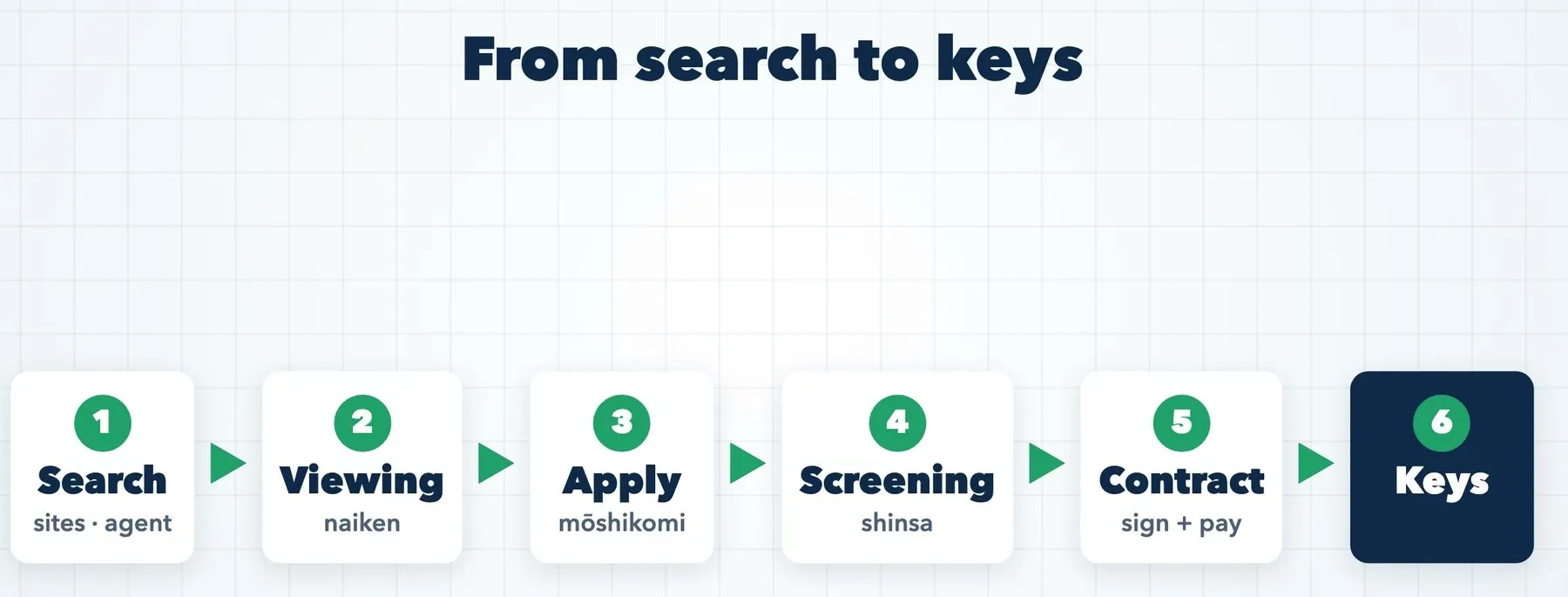
To rent an apartment in Japan as a foreigner, you follow the same steps as a Japanese tenant: set a budget, find a place through a licensed real estate agent, apply, pass screening by the landlord and almost always a rent guarantor company, hear the legally required explanation of the contract, then sign and pay the move-in money. The Ministry of Land, Infrastructure, Transport and Tourism (MLIT) gives a rule of thumb of 4 to 7 months’ rent for the money due at signing, and says it usually takes 1–2 weeks from application to move-in. After you move in, you have 14 days to register your address at the ward office.
This guide covers each step in order, with the rules as of November 2026. Every section links to a more detailed guide when you need one.
The renting process at a glance
| Step | What happens | Who you deal with |
|---|---|---|
| 1. Budget | Decide your rent ceiling and how much cash you need up front | You |
| 2. Search | Browse portals, visit local agents, shortlist listings | Agent (仲介会社) |
| 3. Viewing | Visit the apartment, check the area | Agent |
| 4. Application | Fill in the application form, submit documents | Agent |
| 5. Screening | Landlord and guarantor company review you | Landlord, management company, guarantor company |
| 6. Important matters explanation | A licensed specialist explains the property and contract | 宅地建物取引士 at the agent |
| 7. Contract and payment | Sign, pay the initial costs | Agent, landlord |
| 8. Keys and move-in | Collect keys, check the condition, start utilities | Management company, utility companies |
| 9. Address registration | Register at the ward office within 14 days | Ward office |
| 10. Renewal or moving out | Renew the lease, or give notice and settle the deposit | Management company |
Steps 4 to 8 are the fast part. MLIT’s guidebook says the time from application to move-in is usually one to two weeks, so start searching about a month before you want to move, and do not give notice on your current home until you have an approved application.
Can foreigners rent an apartment in Japan?
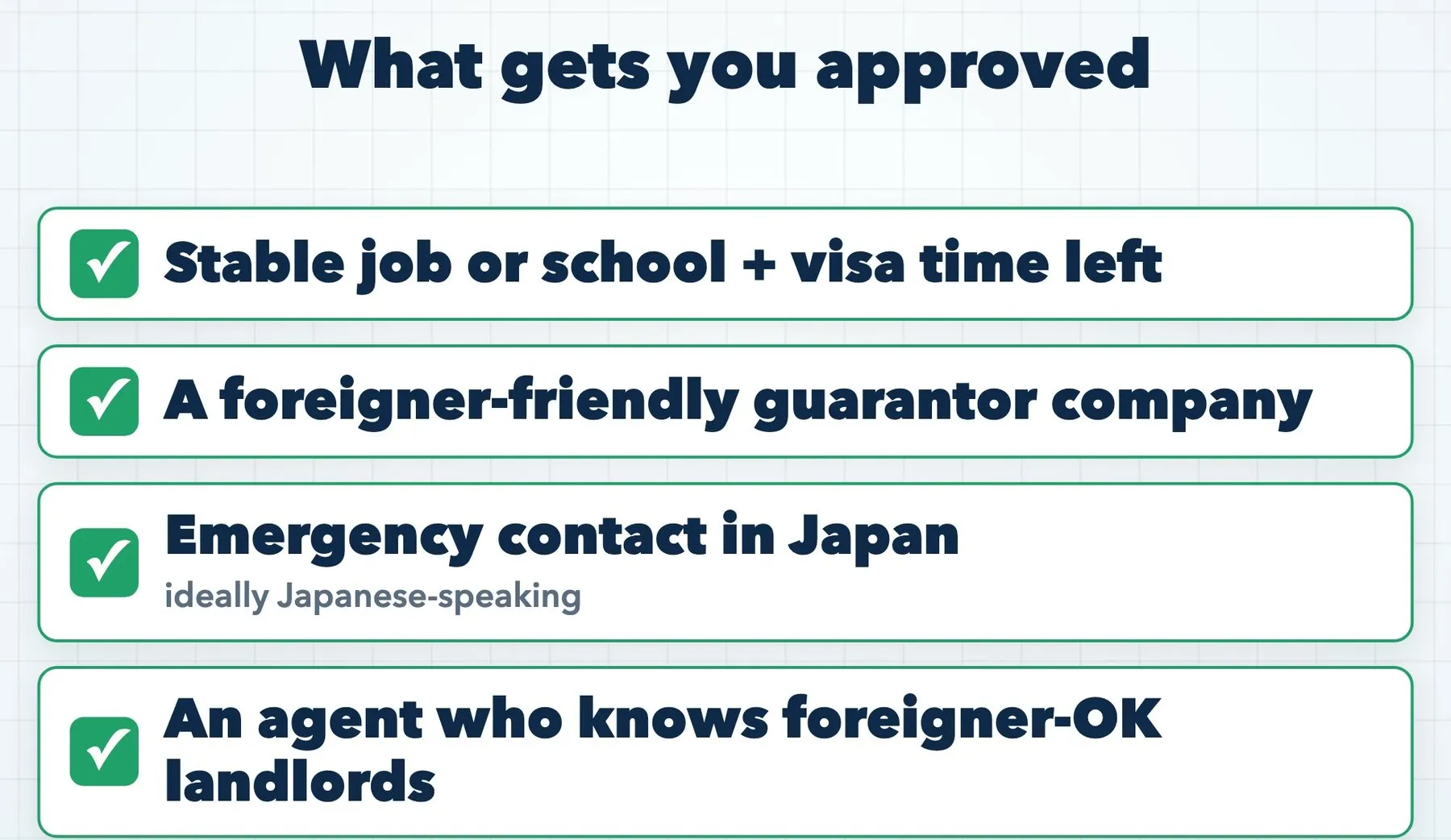
Yes. There is no nationality rule for renting. The landlord decides who to accept, and what they want to see is the same for everyone: a steady income that covers the rent, a residence status that lasts, acceptance by a guarantor company, and a reliable way to contact you.
Refusals still happen. In a Ministry of Justice survey of 4,252 foreign residents (published in 2017), 2,044 people had looked for a home in Japan in the previous five years. Of those:
| Experience in the previous five years | Share |
|---|---|
| Refused because they were a foreigner | 39.3% |
| Refused because they had no Japanese guarantor | 41.2% |
| Gave up after seeing a “no foreigners” notice | 26.8% |
The guarantor problem has changed a lot since then. Rent guarantor companies have replaced the personal guarantor for most leases: in the Japan Property Management Association’s survey for April 2023 to March 2024, 93.0% of responding management companies said they require tenants to use one. MLIT also keeps a public list of registered guarantor companies that offer foreign-language support, with 52 companies as of 30 September 2026.
The honest reasons landlords hesitate, and what you can do about each one, are in why Japanese landlords reject foreigners.
How much rent can you afford in Tokyo?
Start with the rent level, because it decides both your area and the size of your move-in payment. SUUMO’s ward averages for apartment-building units (マンション) give a fair picture of the 23 wards:
| Ward | 1K or 1DK | 1LDK, 2K or 2DK |
|---|---|---|
| Minato | ¥121,000 | ¥237,000 |
| Chiyoda | ¥121,000 | ¥198,000 |
| Shibuya | ¥110,000 | ¥200,000 |
| Shinjuku | ¥107,000 | ¥174,000 |
| Meguro | ¥103,000 | ¥174,000 |
| Koto | ¥100,000 | ¥143,000 |
| Bunkyo | ¥95,000 | ¥168,000 |
| Toshima | ¥90,000 | ¥145,000 |
| Nakano | ¥90,000 | ¥140,000 |
| Itabashi | ¥81,000 | ¥115,000 |
| Nerima | ¥79,000 | ¥115,000 |
| Edogawa | ¥75,000 | ¥97,000 |
Source: SUUMO Tokyo rent averages, updated 10 October 2026. These are averages of advertised rents calculated by SUUMO, so new buildings near big stations cost more and older buildings further out cost less.
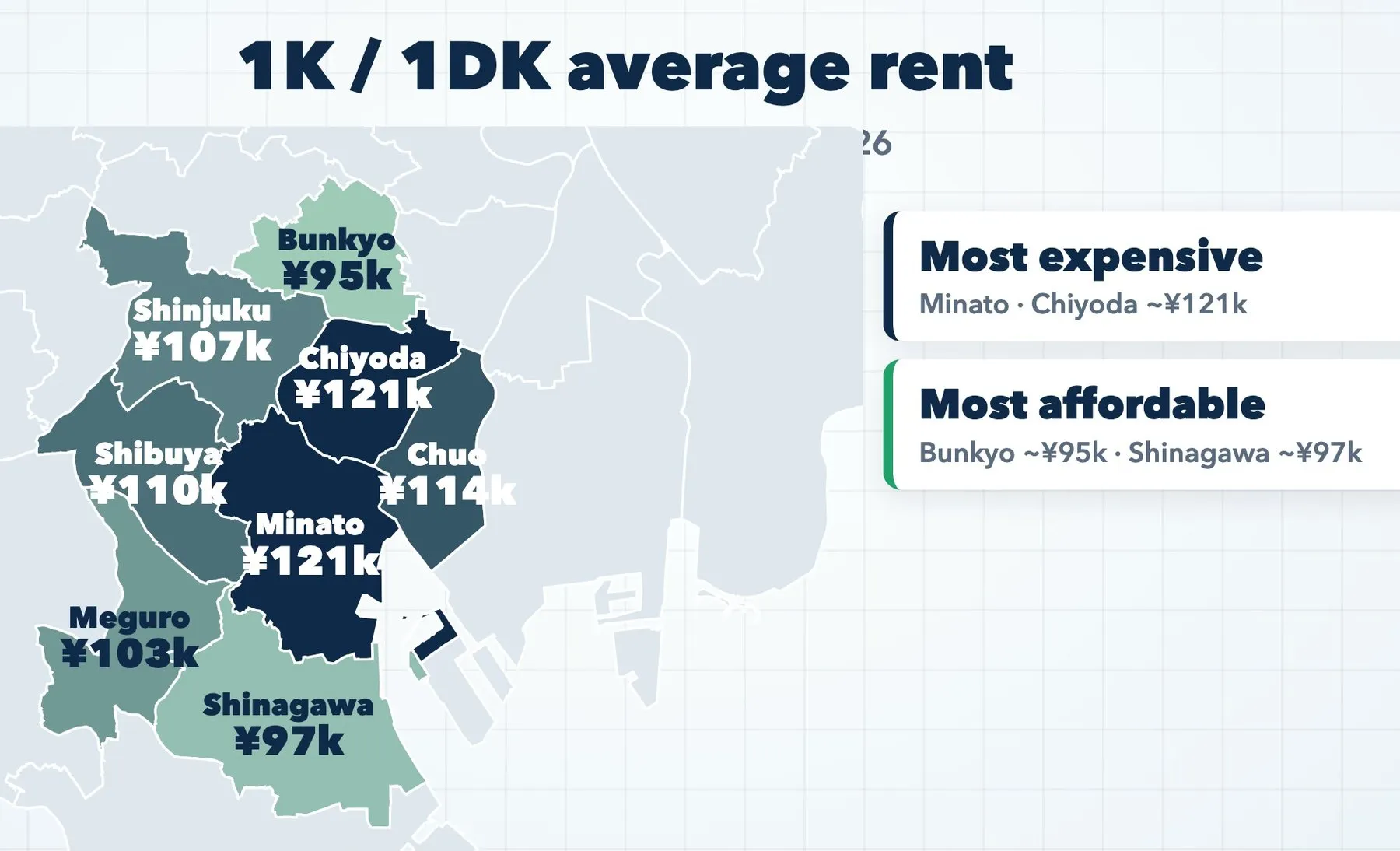
Rents are still rising. The portal at home reported in its September 2026 survey that average advertised rents for apartment-building units in the 23 wards were higher than a year earlier in every size band, and rents for single-person low-rise apartments (アパート) hit their highest level since January 2015 for the 17th month in a row.
How much income do you need? Private landlords and guarantor companies set their own criteria and rarely publish them. The clearest published rule comes from UR, the public housing agency: for lower rents it asks for an average monthly income of at least four times the rent, so a ¥60,000 (about US$377) apartment needs a monthly income of ¥240,000 (about US$1,510). Treat that as a conservative benchmark for private rentals too.
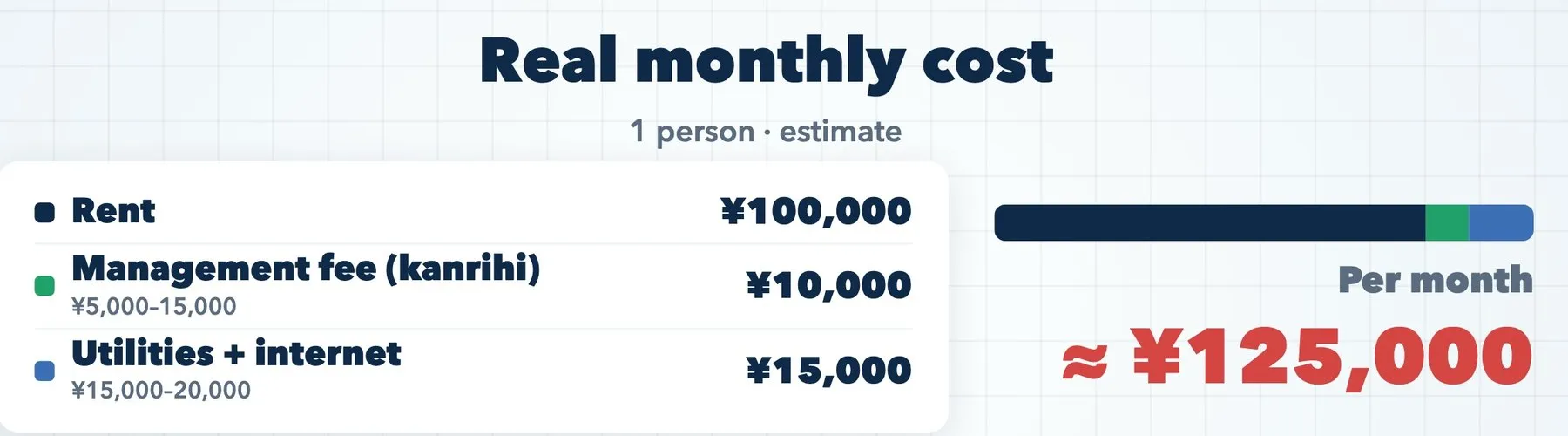
Remember the monthly extras. Japanese rentals usually add a management or common-area fee (kanrihi 管理費 or kyōekihi 共益費) on top of the rent. MLIT’s guidebook notes that rent for the coming month is generally due at the end of the previous month, so you always pay one month ahead.
If you plan to stay for many years, compare the numbers with buying. Our rent vs buy in Tokyo guide runs a worked comparison.
How much does it cost to move in?
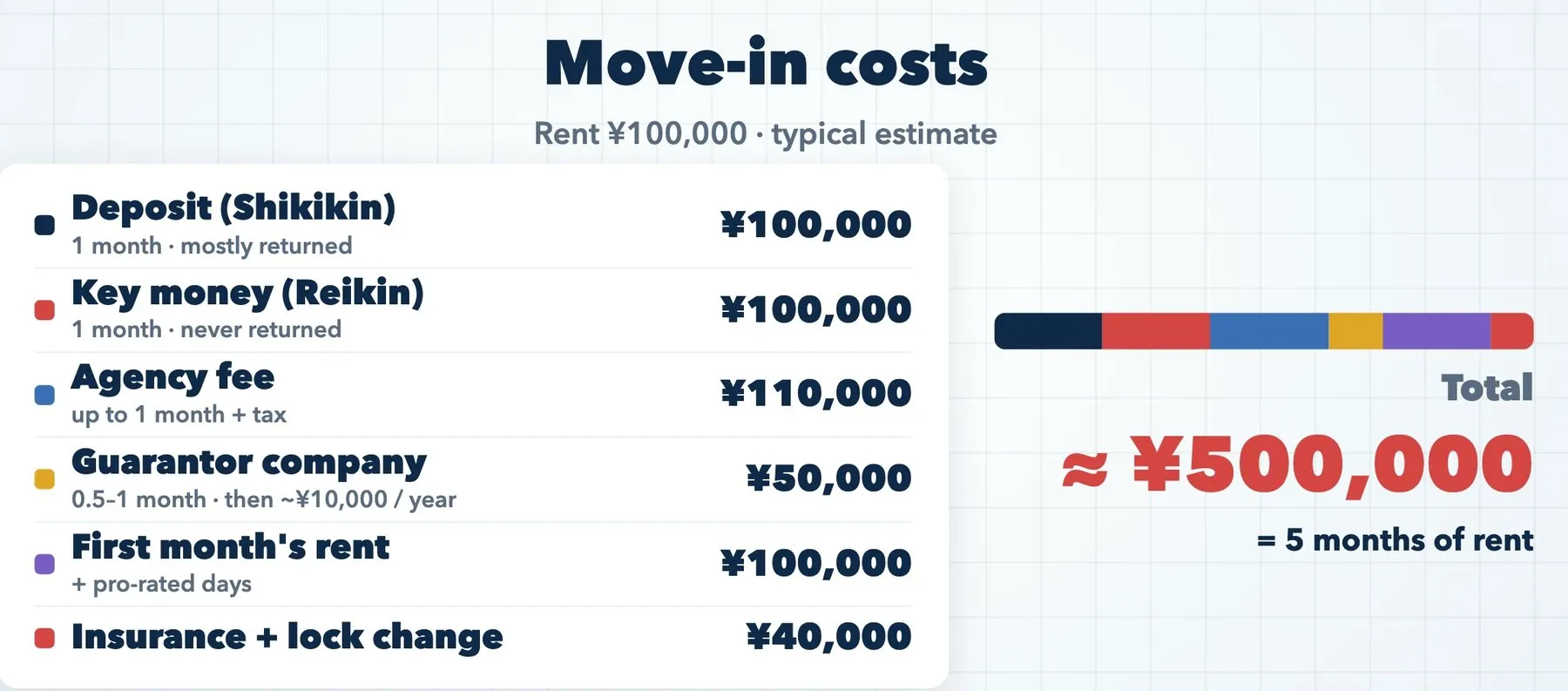
The move-in payment is the biggest shock for most newcomers. MLIT’s rule of thumb is 4 to 7 months’ rent, made up of these items:
| Item | Japanese | What MLIT and the law say | Returned? |
|---|---|---|---|
| Security deposit | shikikin (敷金) | About 2 months’ rent as a guideline in MLIT’s guidebook; the listing shows the real figure | Yes, minus unpaid rent and repair costs |
| Key money | reikin (礼金) | Often required in the Kanto region, usually 1 or 2 months; some listings have none | No |
| Brokerage fee | chūkai tesūryō (仲介手数料) | Legal maximum 1.1 months’ rent including tax, shared between landlord and tenant | No |
| Guarantor company fee | hoshōryō (保証料) | MLIT’s guidebook: often 35–50% of one month’s rent for two years; plans vary | No |
| Contents and liability insurance | kasai hoken (火災保険) | Commonly required at signing | No |
| First month’s rent | maeyachin (前家賃) | Paid in advance, plus prorated rent for a part month | Not applicable |
| Other items | 鍵交換費 and similar | Lock change or cleaning fees may appear on the estimate | Usually no |
A worked example makes this concrete. Assume rent of ¥100,000 (about US$629) plus a ¥5,000 (about US$31.4) management fee, one month’s deposit, one month’s key money, the maximum brokerage fee and a guarantor fee of 50% of the monthly total:
| Item | Amount |
|---|---|
| Deposit (1 month) | ¥100,000 |
| Key money (1 month) | ¥100,000 |
| Brokerage fee (1.1 months) | ¥110,000 |
| Guarantor fee (50% of ¥105,000) | ¥52,500 |
| First month’s rent and fee | ¥105,000 |
| Subtotal before insurance and other items | ¥467,500 |
That subtotal is ¥467,500 (about US$2,940), about 4.7 months’ rent, before insurance, prorated rent and any lock or cleaning fees. Our initial cost guide has a calculator where you can enter your own numbers.
Where should you search for apartments in Japan?
Most listings in Japan are published by licensed agents, not by landlords, and the same few channels cover almost all of them:
- Large portals. SUUMO, LIFULL HOME’S and at home carry most of the rental stock in Tokyo. They are in Japanese, but the filters (rent, layout, walk time, building age) are easy to use with a browser translation tool.
- Local agents. MLIT’s guidebook suggests visiting agents near the station you want; they post listings outside their offices, which also gives you a quick sense of local rents.
- Agents with foreign-language staff. The Japan Property Management Association publishes a list of real estate agents that speak foreign languages.
- Safety Net Housing. MLIT’s guidebook points to the Safety Net Housing website (in Japanese), where you can search registered rentals that accept foreign residents and other people who often struggle to rent.
- Your school or employer. Students should ask the school’s housing office first; some employers have company housing or a preferred agent.
Japanese listings use a compact vocabulary. These are the terms you will see most:
| Term | Meaning |
|---|---|
| 1R | One room with the kitchen in the same space |
| 1K | One room plus a separate kitchen area |
| 1DK, 1LDK | One room plus a dining-kitchen, or a living-dining-kitchen; the number counts the separate rooms |
| 徒歩 X 分 | X minutes on foot to the station |
| 築 X 年 | Building age in years |
| 敷 1 / 礼 1 | Deposit 1 month, key money 1 month |
| 管理費 / 共益費 | Monthly management or common-area fee |
| 定期借家 | Fixed-term lease that ends without renewal |
| 保証会社利用必須 | Guarantor company required |
How do real estate agents work in Japan?
Three parties are involved in most rentals:
- The landlord (大家, ōya), who owns the apartment and makes the final decision.
- The management company (管理会社, kanri gaisha), which runs the building, collects rent and handles repairs. You deal with it after you move in.
- The brokerage agent (仲介会社, chūkai gaisha), which shows you apartments and handles the application and contract. Sometimes the same company manages the building too.
Anyone who brokers rentals must hold a real estate brokerage licence (宅地建物取引業免許) under the Real Estate Brokerage Act. The licence number is shown in the agent’s office and on its website, and you can check it in MLIT’s licensed broker search.
The brokerage fee has a legal cap. For a home rental, the total the agent may receive from landlord and tenant together is 1.1 months’ rent including consumption tax. From each side, the cap is 0.55 months’ rent, unless that side agreed in advance, when asking the agent to broker the deal, to pay more. MLIT’s interpretation says the consent must be obtained when the agent takes on the request; consent given afterwards does not count. Read the papers you sign when you first ask an agent for help: if they include a clause agreeing to pay more than 0.55 months, that is the consent.
A 2024 special rule lets agents charge the landlord up to 2.2 months’ rent for long-vacant properties. It does not raise the cap for tenants, and MLIT says it does not cover vacant units in rental buildings that are being advertised normally.
What should you check at a viewing?
Viewings (内見, naiken) are free, and MLIT’s guidebook confirms you do not have to apply after viewing if you are not satisfied. Book them through the agent; some agents offer video viewings if you cannot attend.
| Check | Why it matters |
|---|---|
| Space for a fridge and washing machine | Many small units have a fixed washing-machine space; measure it |
| Kitchen, air conditioning, water pressure | Fixed equipment is hard to change later |
| Sunlight and noise at the time you would be home | Ground-floor and railway-side units differ a lot |
| Garbage collection point and building rules | Garbage rules cause many disputes with neighbours |
| Mobile signal and internet type | Some buildings have a pre-installed line |
| Walk to the station, supermarkets, clinics | Listing walk times assume a direct route |
| Flood and earthquake risk | Check the ward’s hazard map; the agent must also show the flood hazard map location before you sign |
Take photos and notes for each unit. After three or four viewings in one day, the details blur together.
How do you apply for an apartment?
- Fill in the application form (入居申込書, nyūkyo mōshikomisho). MLIT publishes a sample in 14 languages, which helps you understand the Japanese version.
- Submit documents. The agent passes them to the landlord and the guarantor company.
- Pay any application fee only after checking the refund rule. MLIT’s guidebook tells tenants to confirm whether an application fee is returned if the contract does not go ahead.
- Wait for the screening result before you pay anything else.
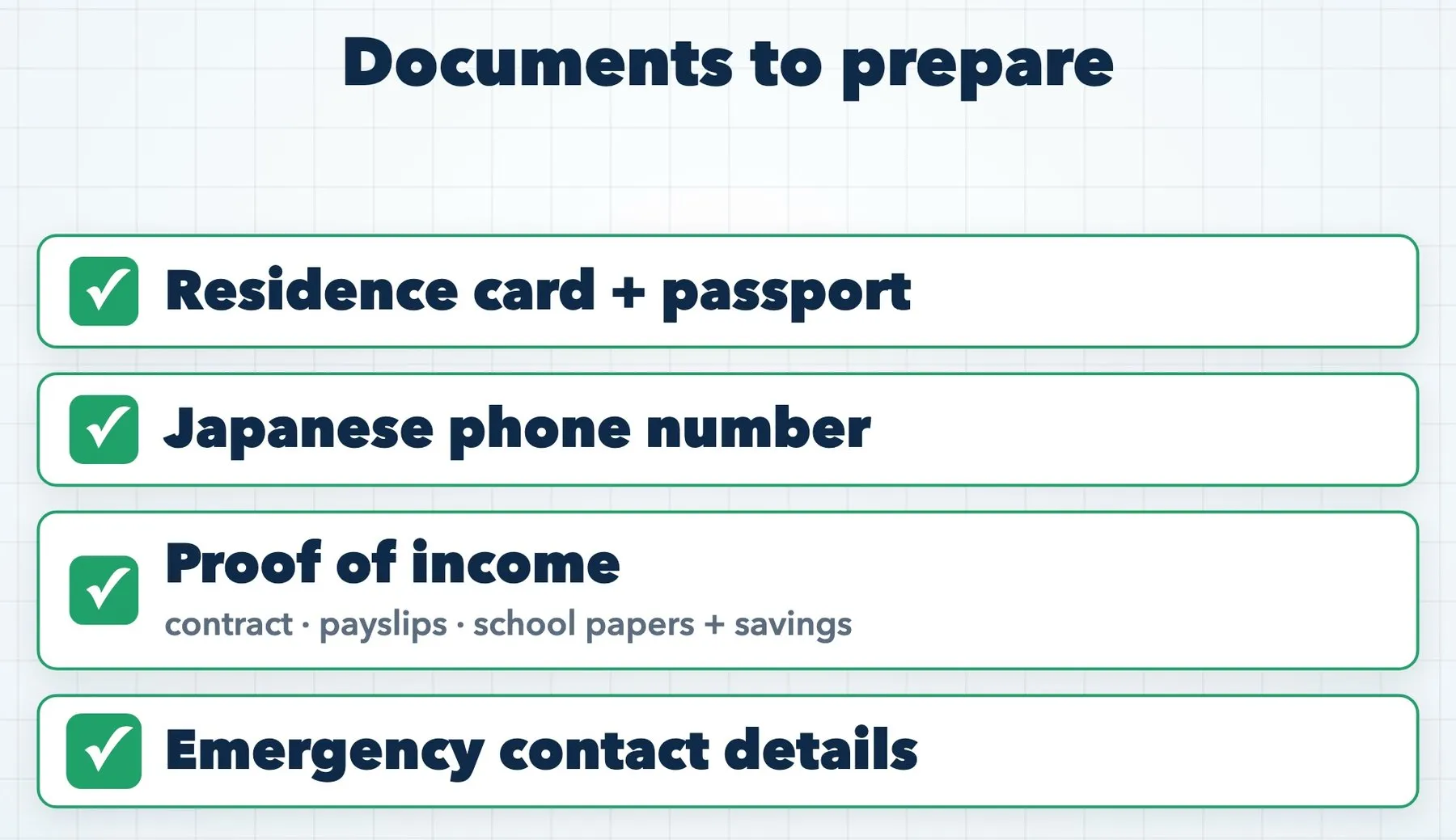
The documents are mostly the same everywhere:
| Document | Notes |
|---|---|
| Residence card and passport | Copies of both sides of the residence card |
| Proof of income | Salary slips, a tax certificate or a job offer letter |
| Employment certificate or student certificate | 在職証明書 or 在学証明書 |
| Emergency contact details | Guarantor companies such as Nihon Safety ask for a home-country contact form as well as a contact in Japan |
| Japanese phone number | Needed for screening calls |
| Personal guarantor’s documents | Only if the lease uses a personal guarantor: their proof of income and seal certificate |
How does tenant screening work in Japan?
Screening (入居審査, nyūkyo shinsa) has two layers. The landlord or management company decides whether they want you as a tenant, and the guarantor company decides whether it will guarantee your rent. Both must say yes.
MLIT’s guidebook lists what agents generally ask about: your name, occupation, who will live with you, income, Japanese ability and why you are moving. Screeners also look at whether the rent is affordable for your income, how long you have been in your job, and whether you can be reached in an emergency. The remaining period on your residence card can matter too, especially for a two-year lease.
If you are rejected, ask the agent whether the landlord or the guarantor company said no, because the fix is different. The realistic next steps are a different guarantor company through a different agent, a cheaper unit, or one of the options in renting without a guarantor.
Do you need a guarantor or a guarantor company?
You almost always need a guarantor company (家賃債務保証会社, yachin saimu hoshō gaisha). It promises to pay the landlord if you do not pay, and then collects the money from you. It is not insurance: MLIT’s guidebook stresses that the company will bill you for any rent it pays on your behalf.
Fees vary by company and plan. MLIT’s guidebook says the fee is often 35–50% of one month’s rent for two years, and a 2016 MLIT review of guarantor companies found that a common model was 50% of the monthly rent up front and ¥10,000 (about US$62.9) a year after that. Each property often works with specific guarantor companies, so ask which one applies before you apply.
Two rule changes matter for foreign tenants:
- Registration. MLIT has run a voluntary registration system for guarantor companies since October 2017. It listed 125 registered companies as of 30 September 2026, and 52 of them offered foreign-language support.
- Certification (new from October 2025). The revised Housing Safety Net Act, in force since 1 October 2025, created “certified” guarantor companies that must be easy to use for people who struggle to rent, including foreign residents. MLIT’s criteria include not requiring a personal guarantor and not limiting emergency contacts to relatives. Twelve companies were certified as of 31 July 2026.
If a lease asks for a personal guarantor instead, the Civil Code has required since April 2020 that the contract state a maximum amount (極度額) the guarantor can be asked to pay; without it, the guarantee is void.
The full picture of costs and screening is in guarantor companies in Japan.
What is the important matters explanation (重要事項説明)?
Before you sign, the agent must have a registered real estate transaction specialist (宅地建物取引士, takuchi tatemono torihikishi) explain the key facts about the property and the contract, and give you the explanation document. This is the important matters explanation (jūyō jikō setsumei). The specialist must show their official ID card while explaining.
It can happen online. MLIT treats an online explanation (IT重説) like a face-to-face one when the video and sound are clear in both directions, the signed documents reach you beforehand, you can read them during the call, and the specialist shows their ID card on screen. Since 18 May 2022 the documents can also be sent electronically if you agree.
Listen for these points in particular:
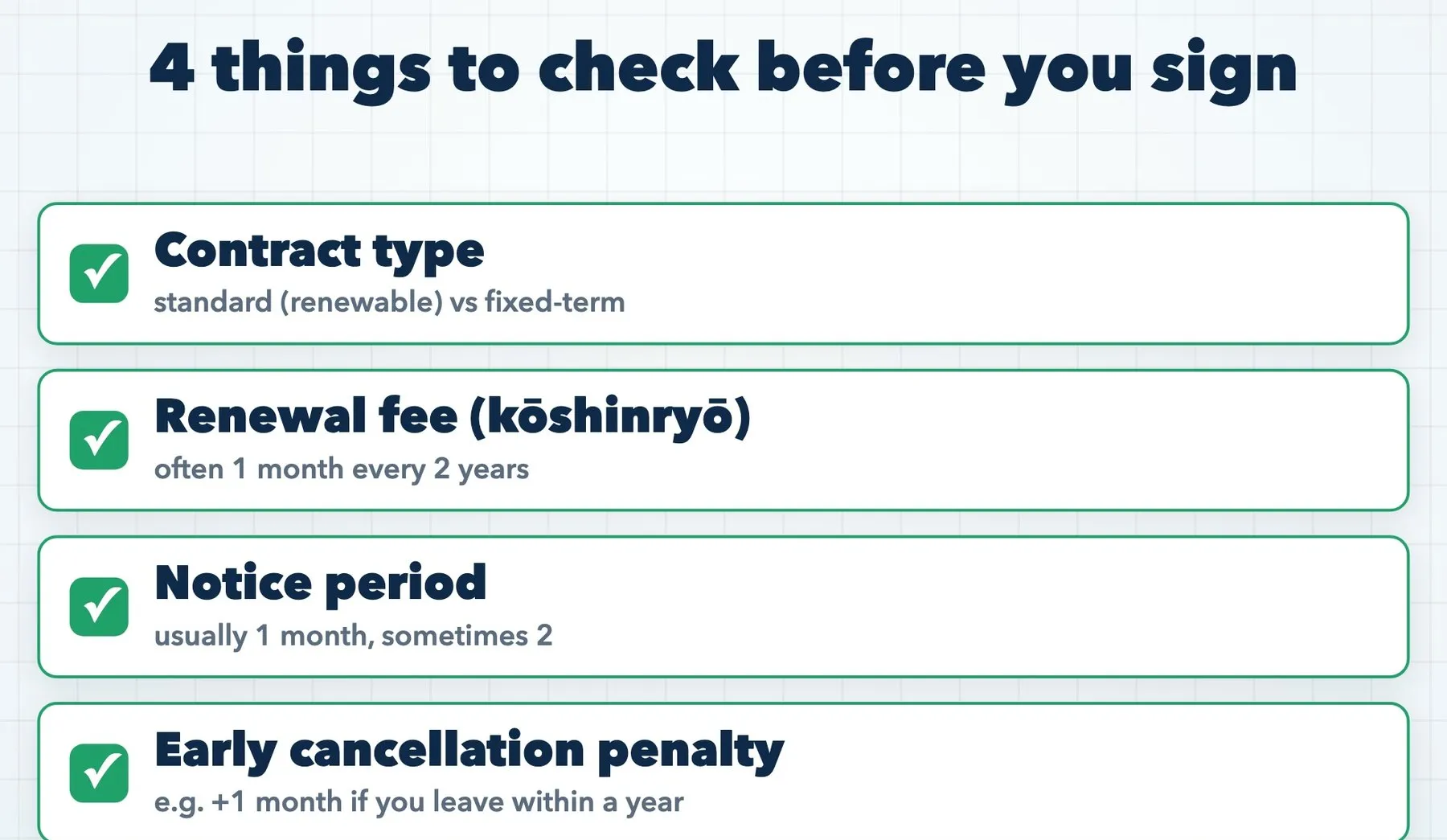
- the type of lease and its length, and how renewal works;
- the rent, fees, deposit and what can be deducted from the deposit;
- how and when you can end the lease;
- who pays for which repairs, and the restoration rules when you leave;
- special clauses (特約, tokuyaku) such as cleaning fees or a short-term cancellation penalty;
- the property’s location on the municipal flood hazard map.
In Tokyo, a metropolitan ordinance also requires agents to explain the basic rules on restoration at move-out and on repairs during the lease. The Tokyo Metropolitan Government publishes an English version of the model explanation.
The type of lease changes your rights more than any other clause:
| Standard lease (普通借家, futsū shakuya) | Fixed-term lease (定期借家, teiki shakuya) | |
|---|---|---|
| At the end of the term | Continues unless the landlord has a justifiable reason to refuse | Ends; a new contract needs both sides to agree |
| Landlord’s notice | Notice of non-renewal 1 year to 6 months before the end, and a justifiable reason | For terms of 1 year or more, notice 1 year to 6 months before the end |
| Common use | Most long-term rentals | Short or set-period rentals, some share houses and furnished units |
Our guide to the Japanese rental contract translates the common clauses.
How do you sign the contract and pay?
After the explanation you sign the lease (賃貸借契約書, chintaishaku keiyakusho) and pay the initial costs. MLIT’s guidebook says payment is generally made by bank transfer or in cash, and the keys are handed over only after the money arrives.
- Electronic contracts are possible. Since 18 May 2022 the agent’s contract documents can be delivered electronically with your consent, and the Act on Land and Building Leases treats an electronic fixed-term lease as a written one. Ask the agent which method it uses.
- Check the start date. Rent starts on the contract start date, not on the day your furniture arrives. If you need a gap, negotiate the start date before you sign.
- Set up rent payment. Ask how rent is collected (bank transfer, automatic debit or through the guarantor company) and fill in the forms promptly so your first payment is not late.
- Keep copies of the contract, the explanation document and every receipt. You will need them at renewal and at move-out.
What happens on move-in day?
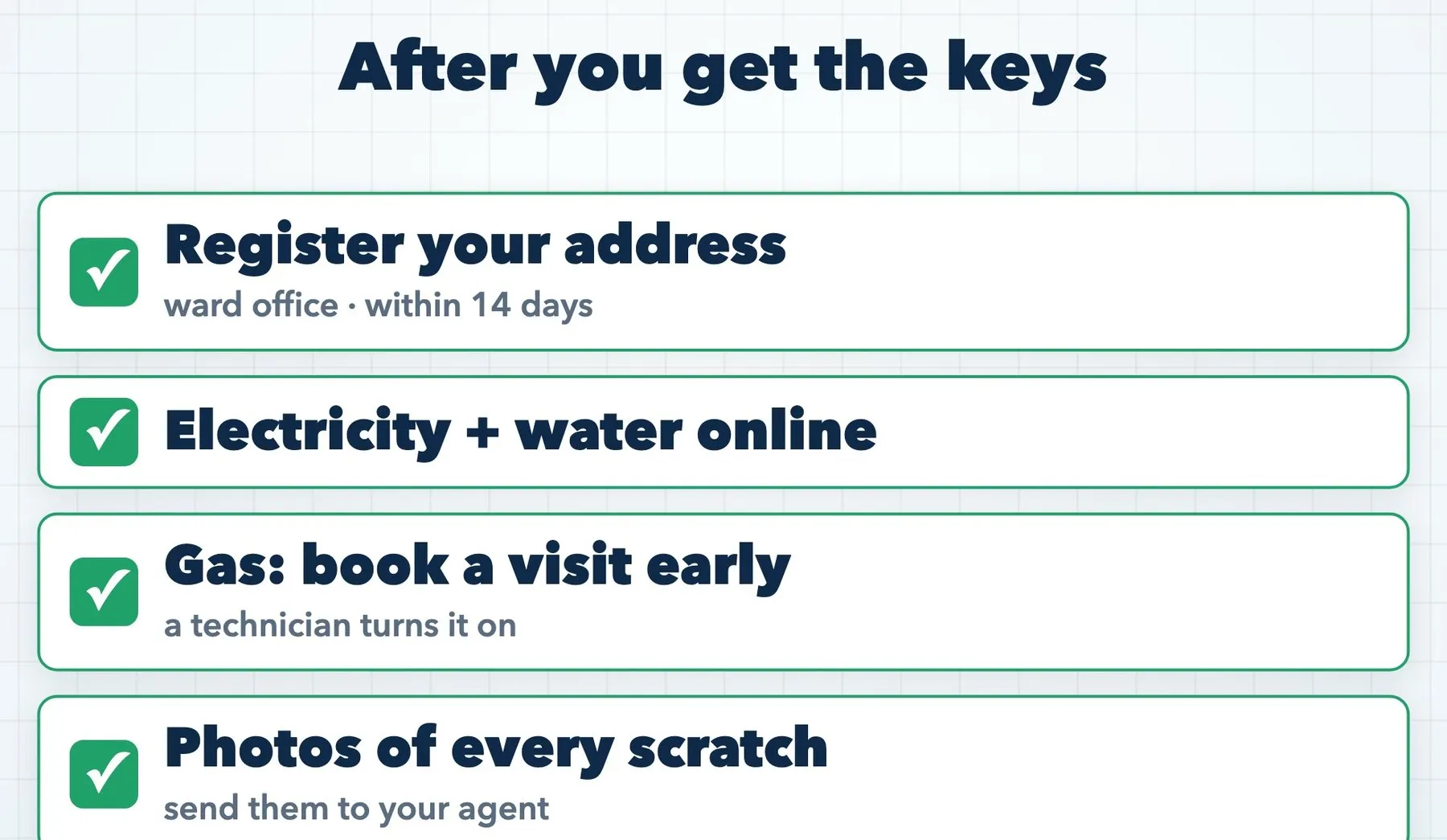
Check the condition before you unpack. MLIT’s guidebook recommends walking through the apartment, ideally with the agent, marking any damage or dirt on a simple floor plan and attaching dated photos. Send a copy to the management company. This record protects your deposit when you leave.
Start the utilities. You contract each service yourself:
| Service | What to do |
|---|---|
| Electricity | Apply online or by phone to a supplier; Tokyo Gas, for example, says no one needs to be present to start electricity |
| Gas | Book a start appointment in advance; Tokyo Gas requires someone to be present (a proxy is allowed) for the safety check |
| Water | Apply to the Tokyo Waterworks Bureau, which has an online moving procedure |
| Internet | Apply early, because some lines need an installation visit |
Learn the garbage rules. Each ward sets its own collection days and sorting rules. MLIT’s guidebook warns that garbage put out on the wrong day is not collected and often causes trouble with neighbours. Ask the agent or the ward office for the local calendar.
What must you do at the ward office after you move in?
Register your address within 14 days. Under the Immigration Control Act, a mid- to long-term resident must notify the municipality of their address within 14 days of settling in, by presenting the residence card at the ward office. The same 14-day rule applies each time you move. When you move to a different ward, you file a moving-out notice at the old ward office first and a moving-in notice at the new one within 14 days.
The deadline is serious. The Act lists failure to report a new address within 90 days, without a justifiable reason, as a ground for revoking your status of residence.
At the same visit you can usually handle these:
- Residence card. If your passport was stamped “residence card to be issued later” at entry, the Immigration Services Agency asks you to show the passport at registration; the card is then mailed to your registered address.
- National Health Insurance. If you are not covered by an employer’s health insurance, you join National Health Insurance at the ward office. Shinjuku’s foreign residents page is a good example of what wards explain in English.
- New residence card design. Since 14 June 2026, newly issued residence cards use a new design, and you can choose a “specified residence card” (特定在留カード) that combines the residence card and the My Number card. It is optional; two separate cards remain valid.
Visa questions are outside the scope of a renting guide. For your own case, ask the Immigration Services Agency or an administrative scrivener (行政書士, gyōsei shoshi).
What happens when the lease is up for renewal?
MLIT’s guidebook notes that the contract period is normally two years. What happens at the end depends on the lease type.
Standard lease. It continues. Under the Act on Land and Building Leases, a landlord who wants to refuse renewal must give notice 1 year to 6 months before the end of the term and must have a justifiable reason (正当事由, seitō jiyū); if no notice is given, the lease is treated as renewed on the same terms. Leases often include a renewal fee (更新料, kōshinryō); the amount is written in the contract. Our renewal fee guide explains the process and what is negotiable.
Rent increases. With rents rising, the Tokyo Metropolitan Government updated its advice in March 2026 on rent-increase demands, especially after a building changes owner. Its points:
- a rent increase needs the agreement of both sides; you do not have to accept it;
- you can keep living in the apartment by paying the current rent;
- if the landlord refuses your payment, you can deposit the rent with the legal affairs bureau (供託, kyōtaku) as proof of payment;
- a landlord cannot refuse renewal just because you did not accept a higher rent;
- once you sign an agreement to a higher rent, it is hard to undo.
The Tokyo government runs a rent-increase consultation line (賃貸ホットライン) on 03-5320-4958 on weekdays.
Fixed-term lease. It ends at the end of the term. For terms of one year or more, the landlord must notify you 1 year to 6 months before the end. A new contract is possible only if both sides agree. If you rent a home under 200 square metres on a fixed-term lease and cannot keep living there for an unavoidable reason such as a job transfer or medical treatment, the law lets you end it with one month’s notice.
How do you move out and get your deposit back?
- Give notice in writing within the period in your contract. MLIT’s standard contract uses at least 30 days, and MLIT’s guidebook says one to two months is usual. Check whether rent is charged by the day or the month after notice.
- Stop the utilities. MLIT’s guidebook advises telling the electricity, gas and water providers at least a week before you leave.
- Book the move-out inspection. The management company compares the unit with its condition at move-in. Bring your move-in photos.
- Return the keys, including copies.
- Wait for the deposit settlement, which lists any deductions.
You do not pay for normal wear and ageing. The Civil Code says a tenant must restore damage caused after moving in, but not ordinary wear from normal use or ageing, and not damage that is not the tenant’s fault. The landlord must return the deposit minus unpaid rent and other amounts you owe under the lease. MLIT’s restoration guidelines explain which costs fall on which side, and in Tokyo the agent must explain these rules before you sign.
Leaving Japan. If you are leaving the country, file a moving-out notification (転出届, tenshutsu todoke) at the ward office before you go; the Basic Resident Registration Act requires it in advance. Give the management company an overseas contact and bank details for the deposit refund.
Everything about notice, deductions and disputes is in our moving-out and deposit guide.
Are there alternatives to a standard lease?
A two-year lease is not the only way to live in Tokyo, and it is often not the best first step.
| Option | Upfront cost | Guarantor | Best for |
|---|---|---|---|
| Share house | Usually low; some operators advertise no key money or guarantor | Often not required | Newcomers, short stays, people who want company |
| Monthly furnished apartment | Monthly price includes furniture; upfront fees vary by operator | Varies by operator | The first weeks or months after arrival |
| UR public rental housing | Deposit of 2 months’ rent; no key money, brokerage fee, renewal fee or guarantor | Not required | Families and long stays with sufficient income or savings |
| School dormitory | Low; most school dorm residents in JASSO’s survey paid under ¥40,000 a month | Less often required than for private apartments | International students |
| Company housing or corporate lease | Paid or arranged by the employer | The company signs | Transferees and some new hires |
UR sets an income standard (four times the rent for lower rents, or a savings or prepayment alternative) and asks for a certified copy of your resident record, so you can only apply after you register an address in Japan.
For the trade-offs between sharing and living alone, see share house vs apartment. If you are still overseas, read renting before you arrive. Students have extra options covered in student apartments in Tokyo.
Where can you get help with a rental problem?
| Problem | Where to go |
|---|---|
| Disputes with a landlord or agent in Tokyo (deposits, rent increases, repairs) | Tokyo Metropolitan Government rental hotline, 03-5320-4958 |
| Free legal consultation on a property dispute in Tokyo | Tokyo real estate consultation room with lawyers and judicial scriveners, by reservation on 03-5320-5015 |
| A guarantor company’s collection practices or contract terms | Consumer Hotline 188 |
| Being refused or treated unfairly because you are foreign | Ministry of Justice foreign-language human rights hotline, 0570-090-911, weekdays 9:00–17:00 |
| General questions about life and residence in Japan | Foreign Residents Support Center (FRESC) in Yotsuya, 0570-011000 |
This guide is general information, not legal advice. For a dispute about your own lease, a lawyer (弁護士, bengoshi) or, for smaller claims, a judicial scrivener (司法書士, shihō shoshi) can tell you where you stand.
Frequently asked questions
Can I rent an apartment in Japan on a tourist visa?
A standard lease is usually not realistic on a short-term visa. Guarantor companies such as Nihon Safety ask for a residence card, and UR asks for a resident record, which short-term visitors do not have. Monthly apartments and some share houses are the realistic options.
Do I need to speak Japanese to rent an apartment in Japan?
No law requires it, but the contract and the important matters explanation are normally in Japanese. MLIT publishes a renting guidebook in 14 languages, and 52 registered guarantor companies offered foreign-language support as of 30 September 2026. Bringing a Japanese speaker to the agent and the explanation is still the safest choice.
Can I negotiate the rent or key money?
Sometimes. Landlords decide, and nothing is guaranteed, but asking politely about key money, the move-in date or a small rent reduction does no harm. A request is easier to accept when your application is otherwise strong.
Who pays for repairs while I live in the apartment?
Under the Civil Code the landlord must make repairs needed to use the property, unless the damage is your fault. Report problems to the management company quickly and in writing, and do not hire a repairer yourself without asking first.
Can a friend or partner move in with me later?
Only with the landlord's permission. MLIT's guidebook warns that letting people live in the unit without permission can lead to eviction, so tell the agent about every occupant before you sign, or ask the management company before anyone moves in.
Sources
- MLIT: Apartment Search Guidebook (English)
- MLIT: Support for Foreign Nationals in Looking for Rental Housing
- MLIT: 宅地建物取引業法の解釈・運用の考え方 (brokerage fees, online explanation)
- e-Gov: 借地借家法 (Act on Land and Building Leases)
- Immigration Services Agency: 在留カードとは (residence card, new design from 14 June 2026)
- SUUMO: 東京都の賃貸家賃相場 (updated 10 October 2026)
- Tokyo Metropolitan Government: 賃貸住宅のオーナーチェンジを契機とした家賃値上げトラブルについて
- Japan Property Management Association: 第28回 日管協短観 (FY2023)
US dollar figures use ¥159 = US$1, the approximate rate on November 16, 2026.
Get the free Tokyo renting checklist
A one-page checklist of what to prepare before you rent in Tokyo, plus new guides by email. No spam, unsubscribe anytime.